From NICU to Preschool: Phahim’s First Big Leap – Thoracic Insufficiency Syndrome
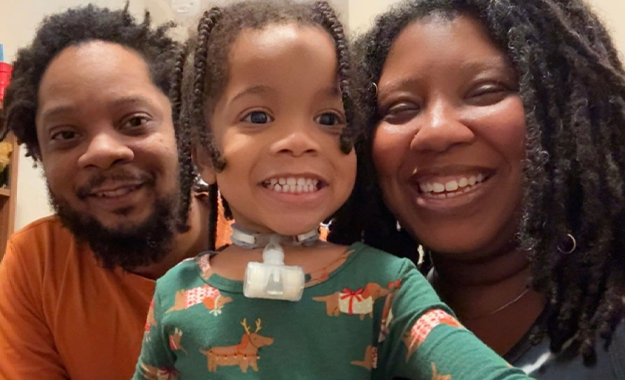
Born with thoracic insufficiency syndrome, Phahim is a spirited toddler with strength, smarts, and something to say.
Every morning, Phahim arrives at preschool with his favorite book in one hand and his AAC tablet in the other. He’s three years old and fully engaged, chatting in sign language with classmates, moving through his day with confidence, and bringing charm and energy into every room.
A Rare Diagnosis Before Birth
At six months pregnant, his mom, Phanice, was told something she didn’t expect to hear: her baby had asphyxiating thoracic insufficiency syndrome, also known as Jeune syndrome. This rare genetic skeletal disorder meant her son’s ribcage would be too small to support healthy lung growth.
Doctors couldn’t predict what would happen after birth. Survival was uncertain, and she was prepared to meet a child who would likely require immediate help to stay alive.
When Phahim was born and let out his first cry, his parents finally exhaled. Their son opened his eyes and moved with newborn strength—kicking, stretching, and curling his little fists. These were good signs, and for a moment, things felt a little less heavy.
But even with a strong start, his condition remained complex and required intensive care. He was transferred to Dale and Karen Sisel Neonatal Intensive Care Unit (NICU) at Brenner Children’s Hospital in Winston-Salem, N.C., where he spent the next five months. During that time, he underwent a tracheostomy, received nutrition through a G-tube, and required constant ventilator support to help him breathe.
Building Confidence in the Face of Complex Care
Those early months at the NICU were demanding. Phahim faced complications that required constant adjustment and vigilance. Still, his mom and dad rose to the challenge. They learned how to operate machines, handle feeds, and respond to alarms—gaining the skills to care for their son with confidence.
As his condition became more stable and their hands-on skills grew, they could imagine life outside the NICU. Taking Phahim home started to feel possible.
“He’s the definition of resilience,” says his dad, Yousuf. “He’s persistent. He smiles through everything. And he has this incredible willingness to live. He’s a fighter.”
Bringing Phahim Home with Expert Respiratory Support
As Phanice and Yousuf prepared to bring their son home from the NICU, they were introduced to Zachary Cardwell, RCP, a respiratory therapist and account executive at PromptCare. He became a trusted presence during the transition, following the family home to oversee the setup of complex equipment and help them adjust to managing Phahim’s care outside the hospital.
That first day home included setting up Phahim’s ventilator, oxygen, and enteral nutrition pump, along with safety checks and emergency protocols. Zachary supported Phanice and Yousuf with in-home training and stayed until they felt confident managing Phahim’s care.
More than anything, Zachary understood the emotional weight of bringing a medically fragile infant home. He showed up with empathy, steadiness, and the time to answer every question. “Zach told us he’d take as much time as we needed, and he meant it,” says Phanice. “He’s been a hugely influential person in our world. He gave us so much hope.”
With Zachary leading the transition, home didn’t just become possible—it felt safe. He helped transform a house filled with new machines and logistics into a space where their son could grow, rest, and be surrounded by family at every moment.
Life-Changing Surgery, Life-Expanding Progress
To give Phahim’s lungs the space to grow, his doctors recommended an uncommon but life-sustaining series of surgical interventions: back-to-back VEPTR procedures, or vertical expandable prosthetic titanium rib implants. Remarkably, the surgeries could be performed at Brenner Children’s Hospital, the same renowned medical center where he had received care since birth. The familiar setting offered comfort, even as the family faced immense uncertainty.
The surgeries were highly complex. Because his lungs couldn’t yet support independent breathing, both operations were performed while he remained on a ventilator and under general anesthesia. The first surgery expanded the right side of his ribcage. Six months later, he returned for a second operation to support the left. During each procedure, surgeons placed titanium rods along his spine and ribs, gradually pushing his chest outward to create space for his lungs to grow.
VEPTR devices aren’t a one-time solution. As Phahim grows, he’ll return to the hospital regularly for expansions—non-invasive procedures where rods are adjusted to further increase chest volume. The ongoing process is critical for improving his lung function over time and supporting long-term quality of life. Though challenging, this surgical path is the only known treatment to address the severe chest-wall restrictions caused by thoracic insufficiency syndrome.
Recovery required careful coordination between surgeons, pulmonologists, and his respiratory and enteral nutrition teams at PromptCare. But the results were clear: Phahim gradually weaned off the ventilator and now uses oxygen only as needed. The trach and G-tube remain part of his daily life, but they’re part of a system that’s helping him thrive.
A Future Full of Progress and Possibility
Today, Phahim is thriving in a classroom that fits him just right. His primary language is American Sign Language (ALS), and he uses an AAC (augmentative and alternative communication) device—a touchscreen speech-generating tablet—to communicate with classmates and teachers.
By chance, the preschool he attends already incorporates sign language into their curriculum for all students. “It’s an environment where communication is normalized, no matter how you do it,” says Phanice. “That was a huge win.”
His medical care may be complex, but his spirit is easy to describe. “He’s just a good time,” says his mom. “He’s funny, he’s bright, and he brings the best energy to every room.”
Behind every milestone are his parents, who have learned to manage what most people can’t imagine. From hospital training to troubleshooting devices in the middle of the night, they’ve adapted to every challenge. “My husband is my best friend,” says Phanice. “We’ve figured out how to do this together. We make a great team.”
Phahim isn’t just surviving his diagnosis. He’s thriving at home and in school. With the right support, compassionate parents who are always by his side, and around-the-clock expertise from PromptCare, he’s charting his own course forward.
He’s a communicator, a classmate, and a learner. And he’s living proof of how far he’s come.
We’ll be here, taking care.
Life-enabling respiratory care requires expertise and consistency. A trusted, familiar face who takes those extra steps.
Ensuring efficient hospital-to-home transitions. Personally delivering equipment and training caregivers. Being there with you. It’s all in a day’s work.
800-776-6782